

Years of Experience VS Hours of Experience
Why years of experience is a weak hiring signal, and a Frequency-of-Work formula for comparing candidates by actual hours worked.

TL;DR
- Years of experience is a weak signal on its own: "10 years, part-time" and "12 years, full-time" aren't the same amount of actual work.
- A simple metric, Frequency of Work (FoW) = (average hours per week ÷ 168) × 100, ranks how consistently someone has actually worked, not just tenure.
- In the worked example below, Jack (20 years, 20 hrs/week) logs fewer total hours and a lower FoW (11.90%) than Jill (10 years, 60 hrs/week, FoW 35.71%).
- I track my own time with Toggl and my productivity with RescueTime, both covered in more depth elsewhere on this blog.
“How many years of experience do you have?” – asked the recruiter.
“~30,000 hours” – I said after a slight pause
“That’s nice, but how many years?” – She said ‘annoyed’
“10 years” – I said ‘slightly more annoyed’
“We are looking for someone with 12 years experience” – She responded, without hesitation
“But….” I TRIED to say….
“You unfortunately don’t have the number of years experience that we require” – She said
“Uuuu ok…” – I said confused and frowning
I didn’t get the role.
Why are we still measuring experience in terms of Years-of-Experience (YoE) instead of Hours-of-Experience (HoE), or even better yet, both metrics?
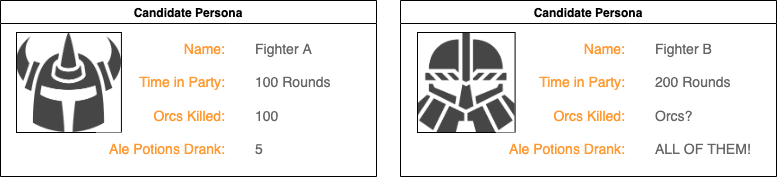
In RPG games you get experience for what you do, not how long you have been with the party/team.
Credit to Carl Olsen and Kier Heyl for the icons.
Who has more experience?
Fighter A who slayed 100 Orcs in 100 rounds or Fighter B who was sipping invisibility ale potions in the background for 200 rounds, screaming “Go for the eyes!”
Current Recruitment
The current recruitment process for full-time/part-time/freelancing roles look something like this:

Now, if a recruiter looks at this, the clear winner is Jack, due to 20 years of experience.
Note: They both started working at the age of 20.
But what if, we add just 1 more stat to those personas, borrowed from the freelance world and some RPG elements.
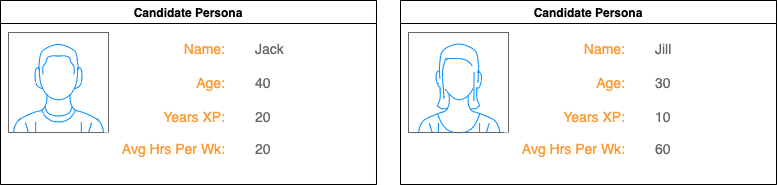
So Jack, a 40 year old individual, has 20 years experience, but has worked part-time (20 hours a week) for those 20 years…
Does that mean he only has 10 years worth of experience?
Jill on the other hand, a 30 year old individual that has 10 years experience. Jill works full time (40 hrs a week), and moonlights for another 20 hours a week (without it affecting her day job of course, and no conflict of interest ;) )
My analytical mind now takes me to working out the sums…
Let's now work 48 weeks a year (holidays, Christmas break, New Years, etc…)
| Persona | Avg hrs/week | Avg weeks/year | Hours/year | Years XP | Hours XP |
|---|---|---|---|---|---|
| Jack | 20 | 48 | 960 | 20 | 19,200 |
| Jill | 60 | 48 | 2,880 | 10 | 28,800 |
Just from the numbers above, we can already see that Jill is the better candidate.
Seeing that we can’t wait 10 years to be able to get a number to emphasise my point, let's come up with a new metric, introducing: Frequency-of-Work (FoW)
Frequency of Work
Let's create a formula
FoW = (AvgHrsPw / MaxHrsPerWeek) * 100
Which will give us a percentage
MaxHrsPerWeek = 7 * 24 = 168
Jack’s FoW: 11.90%
Jill’s FoW: 35.71%
So Jill is the better candidate based on FoW as well as Hours-of-Experience
Note: this does not take into account actual productivity, e.g. meetings, coffee breaks.
Final Thoughts
It’s clear the numbers speak for themselves, if you had to compare Jill and Jack now, and the experience they have, the clear perfect person for the role, in regards to experience, would be Jill.
Recruiters, Companies, Employers all still only look at:
- The paperwork of your education.
- The years of experience the interviewee has
- The honey soaked words from hopeful candidates.
In this day and age where certificates can be bought and salesmen are talking the talk every minute, we need to start asking the questions of “How many HOURS experience do you have?” and the proof that comes with that.
As an employee/candidate or freelancer, start tracking your time, even if it’s just to measure how long things take, and try to get that productivity pulse above 80%.
I personally use Toggl (no affiliation) to track what I do, more on that in How to Work From Home Productively. You need to be honest with yourself, in the end, this is for you alone. Then I also use RescueTime (no affiliation) to track my productivity, covered in Be More Productive with RescueTime, again, honesty is key here.
I believe that it will also demonstrate your ability to do Time Management, and being able to self-motivate.
As employers/clients, start looking more into hours of experience instead of just years. Use the statistics of the candidates as decision factors with all the HR and team fit guidelines that are in place.
If COVID-19 has shown us anything, more and more people will be working from home and tracking time. Productive people strive, and those that require micromanagement will fall behind
Cheers, and keep Time Tracking